


Agentic commerce is starting to become real.
For a while, most of the conversation lived in demos, prototypes, and future-looking takes. That is changing. The infrastructure is maturing, the channels are becoming clearer, and the questions brands need to answer are no longer theoretical. The real question now is whether you are ready to transact inside AI surfaces.
At Lazer, more of our work has shifted into exactly that problem. How do you make a commerce stack that agents can actually read, reason about, and transact against, across Shopify and the major AI assistants?
What we are seeing is a move from "search and scroll" to "ask and buy." New commerce surfaces are emerging through products and protocols tied to Google AI Mode, Gemini, Microsoft Copilot Checkout, ChatGPT, and Shopify’s Universal Commerce Protocol (UCP). Together they create a more direct path between user intent and transaction than the traditional sequence of search, click, browse, and checkout.
That shift has a few important implications.

Agents, Shopify, and the new commerce surfaces
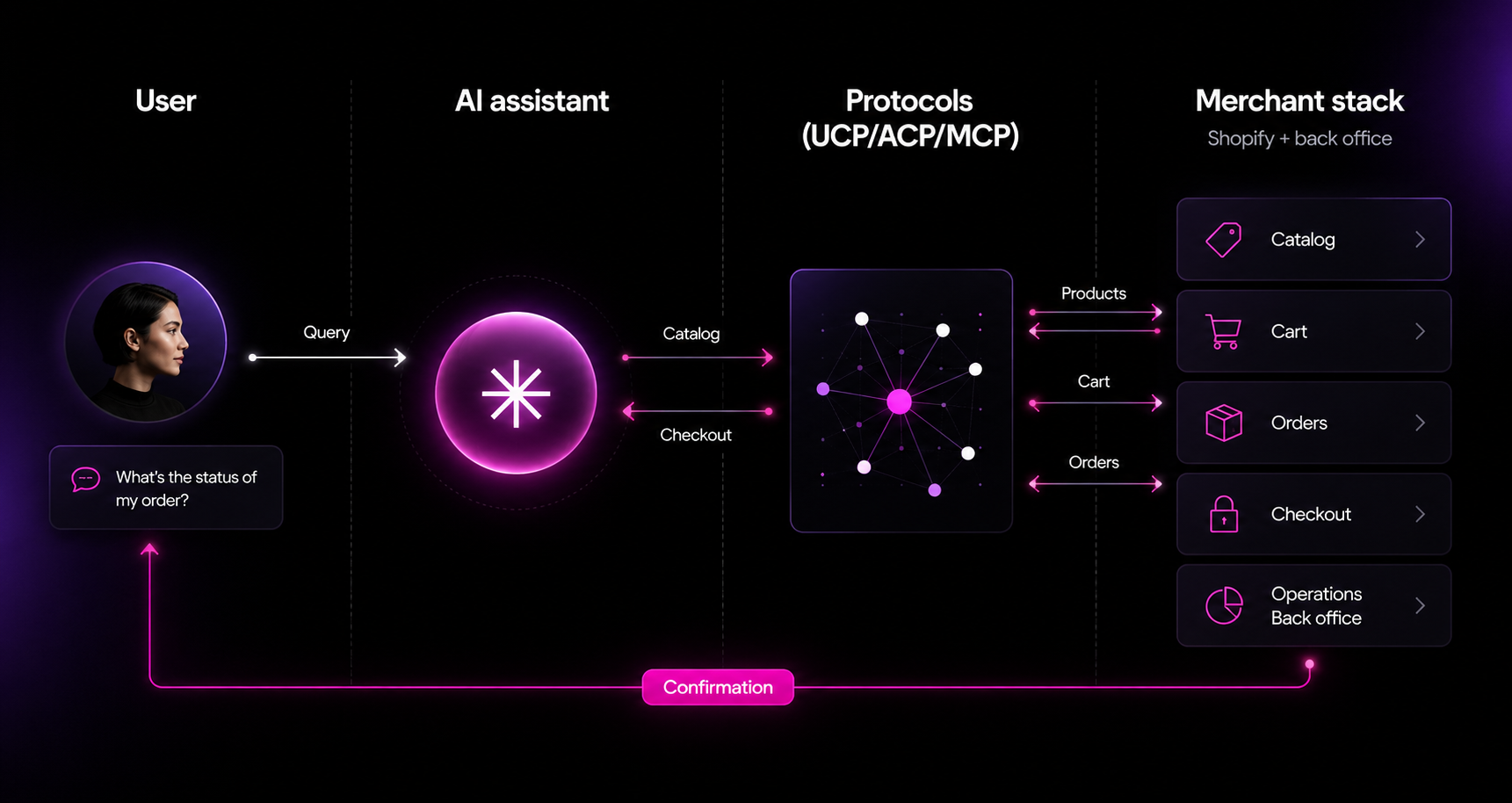
The simplest way to think about agentic commerce is that the "storefront" is no longer only a website. It is also a collection of APIs and protocols that agents speak fluently.
On the assistant side, large models are evolving from chat interfaces into agent platforms. OpenAI introduced agentic commerce in ChatGPT through an embedded checkout that can pull from merchant feeds and complete purchases inside the conversation. Google is pushing AI Mode in Search and Gemini, with UCP as a protocol for agents to talk to merchant systems in a structured way. Microsoft is doing similar work with Copilot Checkout.
On the commerce side, Shopify is positioning itself as a primary surface for these agents. UCP and Agentic Storefronts turn Shopify’s catalog, pricing, and checkout primitives into something AI platforms can query directly, rather than scraping HTML or guessing from unstructured content.
In practice, this means a shopper might say to an assistant:
Find me a vitamin subscription under $80 a month, with delivery this week, and order it.
The assistant interprets the constraints, talks to commerce protocols like UCP or ACP, and either routes to a storefront or completes checkout inside the assistant. The entire flow may finish without the shopper ever seeing a traditional PDP.
For brands and for Shopify’s ecosystem, this is not a hypothetical future. It is a distribution channel that is starting to exist in production. The question is how ready your systems are for that interface.
Why discoverability alone is not enough
Most mature commerce teams are used to thinking in terms of:
• Search and SEO.
• On-site UX and conversion.
• Paid performance and remarketing.
Those still matter. But in an agentic world, they are not sufficient.
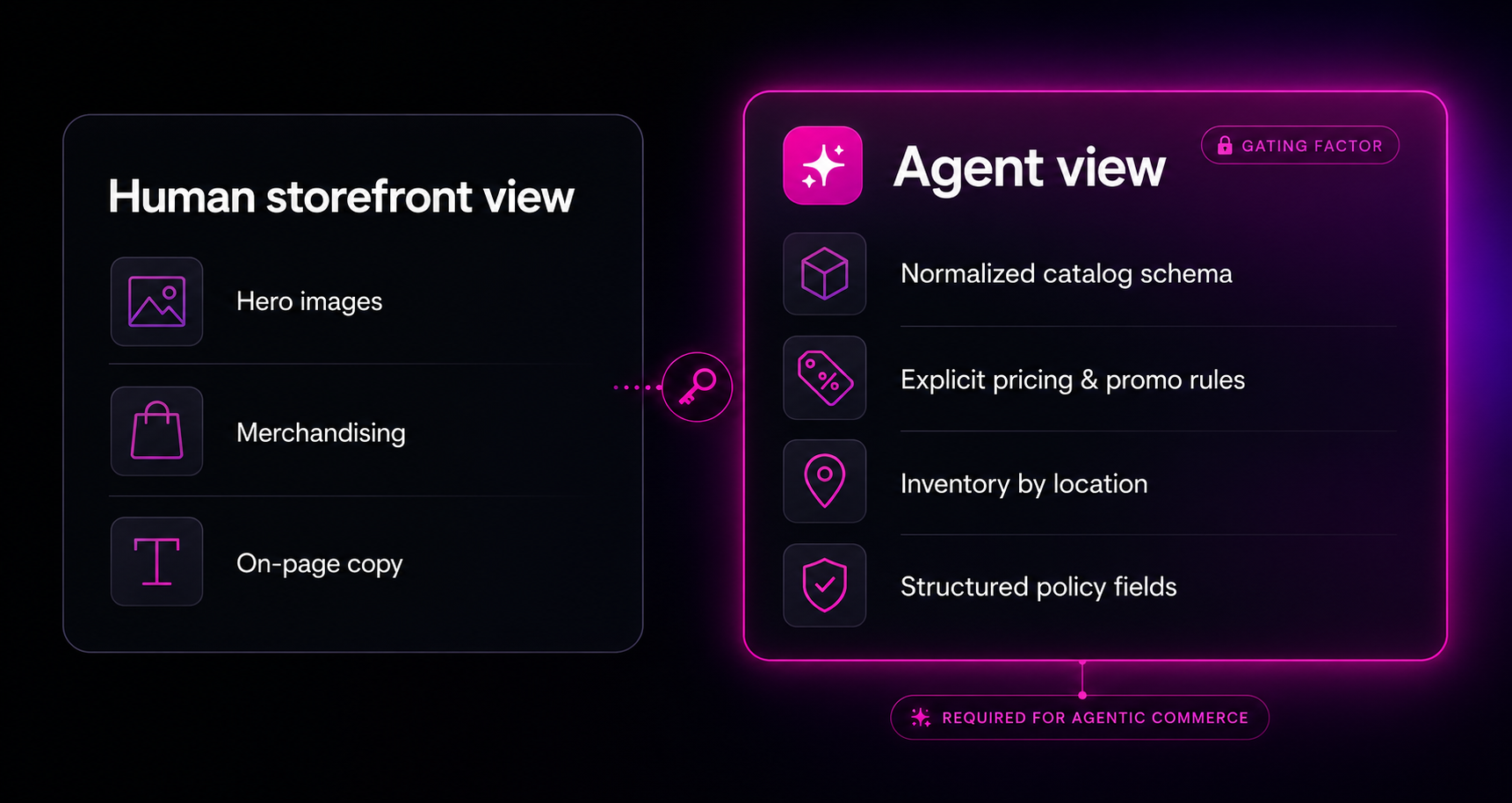
An AI assistant does not see what a human sees. It needs structured signals about:
- Catalog: products, variants, options, and relationships.
- Pricing and promos: base price, discounts, eligibility rules, stacking behavior, and expiry.
- Inventory: availability by location and time, backorders, preorders.
- Policies: shipping windows, returns, subscriptions, and entitlements.
If that information does not exist in a form that UCP, ACP, or similar protocols can read, your products are effectively invisible, no matter how strong your SEO or creative is.
On Shopify, this shows up in concrete ways:
- Metafields used only for display logic instead of structured attributes that an agent can query.
- Promotions encoded as one-off scripts or theme logic instead of explicit rules that can be inspected.
- Inventory and fulfillment logic that lives in external systems without a clear, documented API surface.
From the assistant’s point of view, this is the difference between "I know exactly what this merchant sells and how to buy it" and "I see a pretty website but I cannot act on it."
What real commerce looks like to an assistant
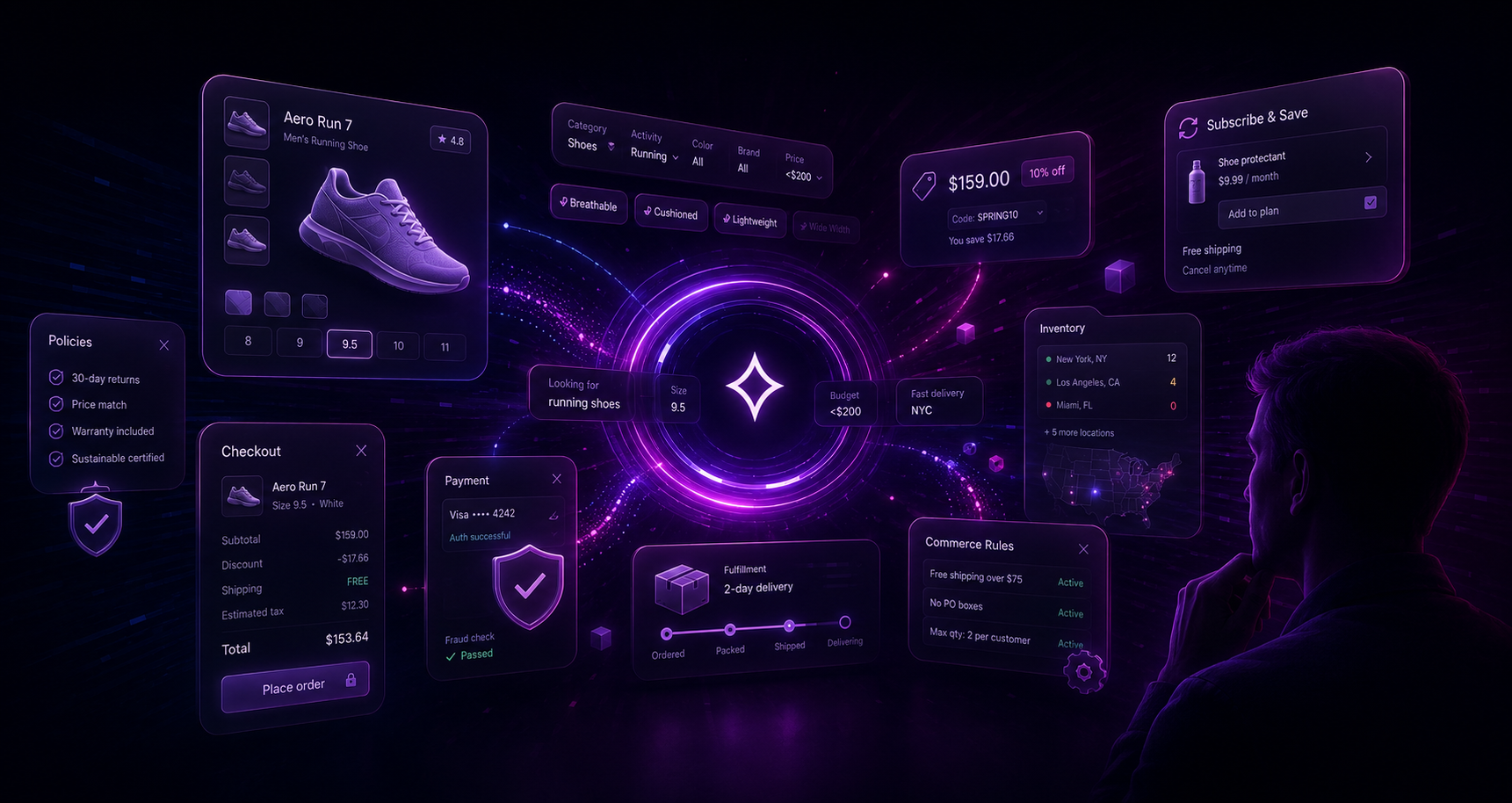
It is easy to imagine agentic commerce as "product retrieval plus a Buy button." In reality, the systems the agent touches are complex, dynamic, and tightly coupled to revenue.
A production commerce flow for an assistant typically needs to handle:
- Intent and constraints
Parse natural language into structured constraints: category, price, brand, size, time, and preferences.
- Discovery and filtering
Query structured catalog data, apply filters, and compare options across merchants or channels.
- Cart management
Add, remove, and adjust items. Handle variants, bundles, subscriptions, and minimums. Respect business rules like "only one discount code" or "subscription-only SKU."
- Checkout
Apply promotions and loyalty, calculate taxes and duties, select shipping options, and validate addresses.
- Payments and fraud controls
Route through the right payment rails, handle 3DS or step-up flows when required, and ensure that confirmation states reflect what actually cleared.
- Fulfillment and post-purchase
Create and update orders, trigger downstream systems, send notifications, and provide status back to the user.
Commerce is not "hard" for agents in the sense of being impossible. It is hard in the sense that there are many moving parts that all have to be consistent with each other and with real-world constraints. Stock changes, promotions start and end, and policies vary by region and channel.
From our engagements, some of the most interesting patterns are:
- Flash-style availability: products that appear and disappear on fixed schedules, where agents need a truthful view of when something can be sold.
- Subscription and add-on rules: combinations that only make sense together, or that change billing and fulfillment semantics.
- Omnichannel inventory: rules about which locations are eligible for which orders, and under what timing constraints.
These are not edge cases. They are the normal state of a scaled commerce operation. Any serious agentic commerce strategy has to account for them.
Measurement for AI surfaces
If you cannot see what is happening, you cannot decide whether to invest.
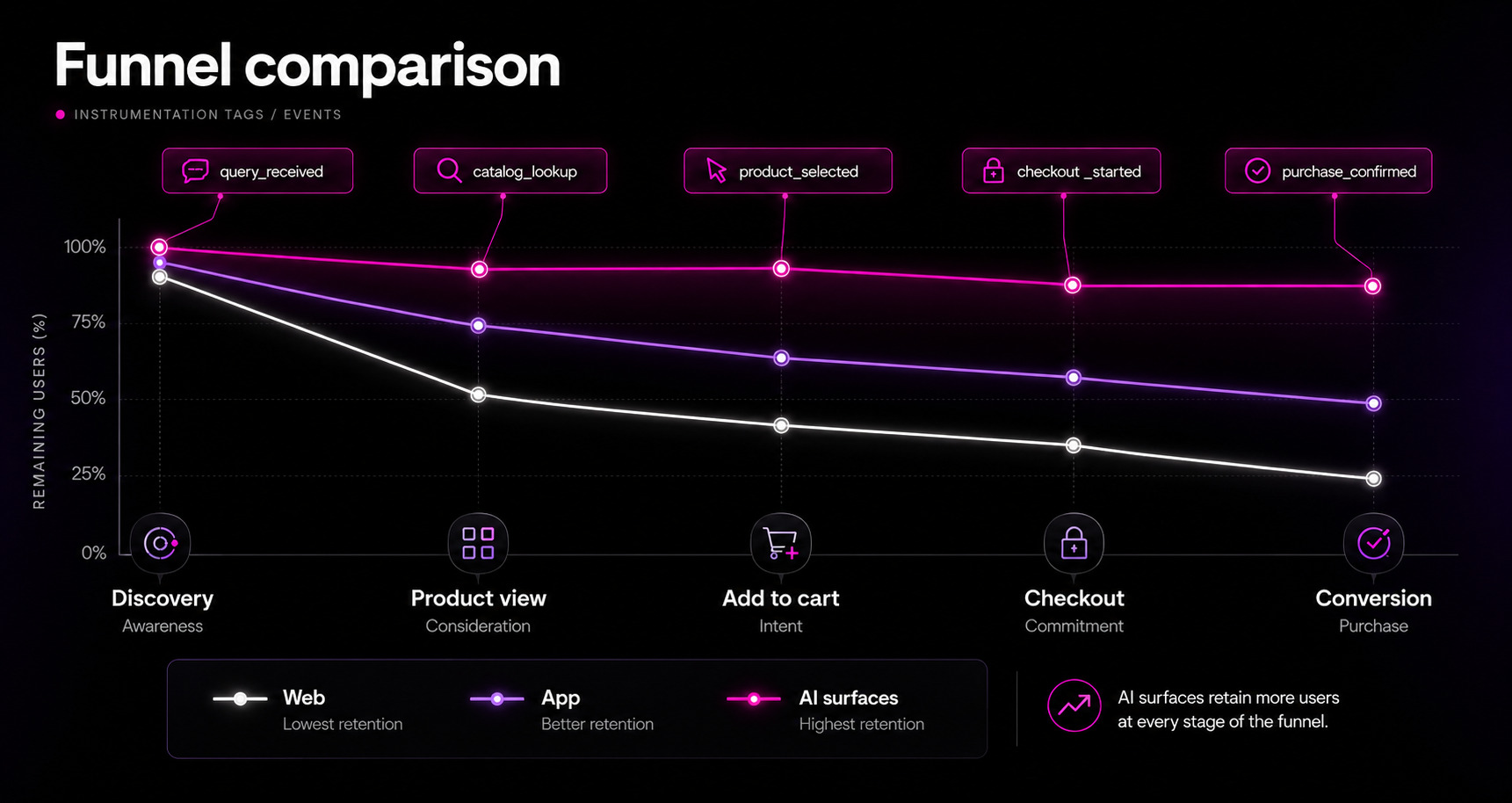
The same is true for agentic commerce. Brands need to understand:
- How much traffic is arriving through AI assistants and agentic surfaces.
- How that traffic converts compared to web and app.
- Whether it is incremental or mostly cannibalizing other channels.
- Where the friction sits in the flow: discovery, cart, checkout, or downstream.
That requires instrumentation that is specific to these channels. At a minimum:
- Tagged entry points from each AI surface back into analytics and warehouses.
- Session identifiers that persist across assistant-driven flows and storefront visits where applicable.
- Events that explicitly mark "agent-recommended" or "agent-executed" orders, so finance and growth teams can attribute revenue correctly.
Without this, "agentic commerce" risks becoming another black box channel that feels important but cannot be managed. With it, brands can treat these surfaces the way they treat any other part of their funnel: instrumented, tested, and iterated.
Making brands agent-ready: the Agentic Commerce Accelerator
One of the concrete ways we address this with enterprise brands is through a structured program we call the **Agentic Commerce Accelerator**. It is less a product and more a blueprint for what it means to be agent-ready on Shopify today.
The accelerator covers five main areas:
1. Agent-readiness assessment
A systematic review of catalog quality, pricing and promotion models, inventory exposure, policies, fulfillment, and returns. The goal is to see which parts of the stack are already compatible with agentic commerce and where schema, APIs, or flows need work.
2. UCP implementation path
Mapping and implementing the flows and extensions required for UCP and related protocols, including how the brand’s systems expose product, cart, and order semantics to agents.
3. Agentic checkout support
Ensuring that discounts, loyalty, subscriptions, and commercial terms are expressed in ways that render correctly and execute safely in agent-led flows. This often surfaces hidden assumptions in legacy checkout logic that were fine for browsers but are opaque to agents.
4. AI channel activation
Configuring and shipping the integrations needed to transact inside AI conversations across ChatGPT, Gemini, Copilot, and others, starting with targeted slices of the catalog before expanding coverage.
5. Measurement and observability
Instrumentation to track discovery-to-checkout conversion from AI channels, with reporting that lets teams see whether this is additive and where improvements are most effective.
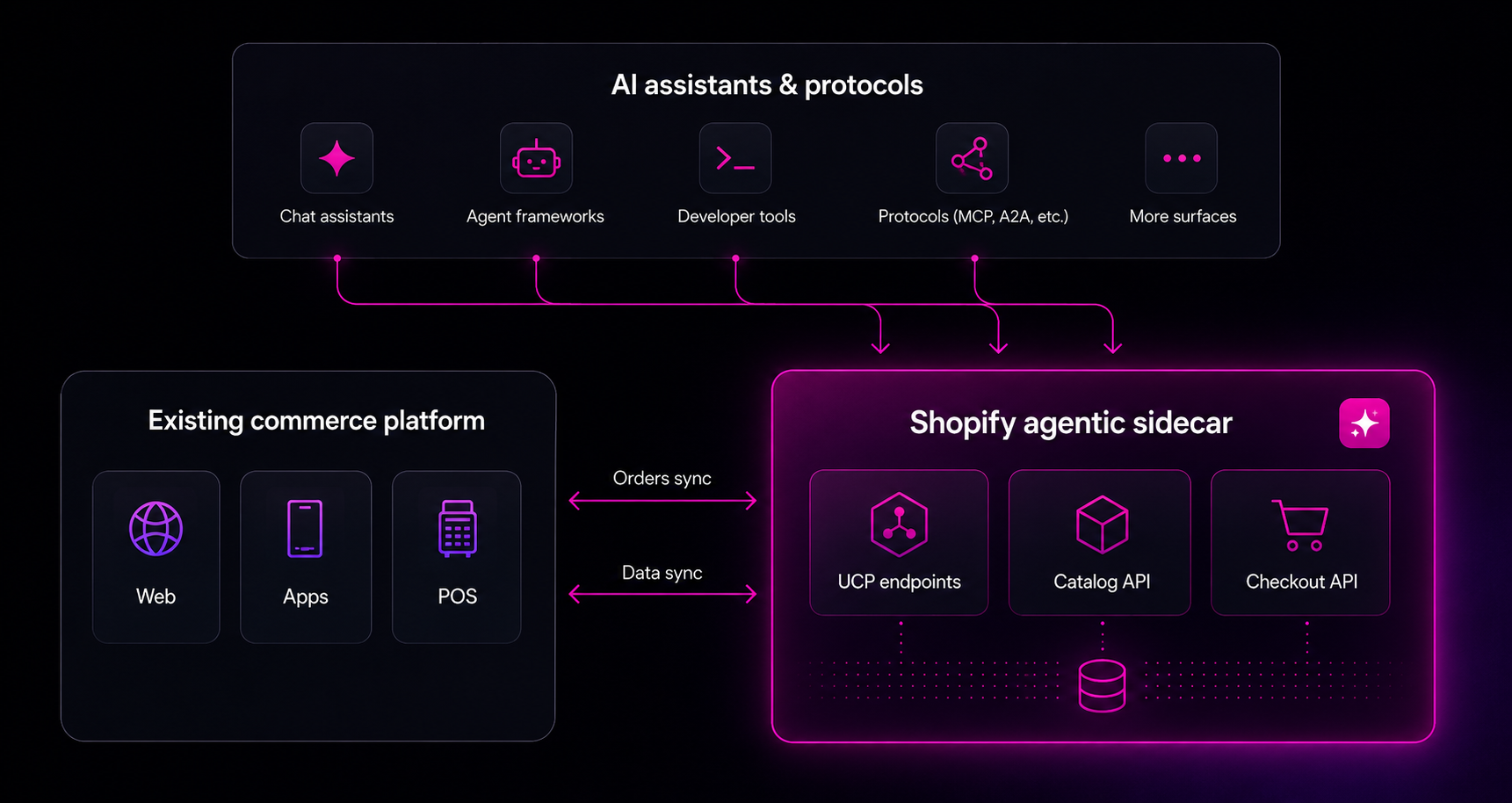
One pattern that has worked well for larger enterprises is using Shopify as an "agentic sidecar" alongside an existing core commerce platform. The main platform continues to power current web and store operations. Shopify sits alongside it with UCP-aligned semantics and cleaner APIs that agents can consume. Orders reconcile downstream into the systems of record.
This gives teams a way to participate in agentic channels without a full replatform. It also forces clarity around what information an agent actually needs, which often improves the architecture for the rest of the stack.
CommerceBench: seeing how agents behave on real tasks
The other major piece of work we have done is CommerceBench, a benchmark and evaluation harness for real-world agentic commerce tasks.
CommerceBench exists for a simple reason. General web benchmarks are useful, but they do not tell you enough about how agents behave in actual commerce environments, especially on Shopify.
The system has three main characteristics:
1. Realistic environments
CommerceBench runs controlled evaluations on real Shopify storefronts and synthetic Shopify-like storefronts that mirror actual layouts, catalogs, and edge cases.
2. Deterministic evaluation
For each task, it tracks whether an agent can complete a full workflow, and records traces, state differences, and session replays so teams can see not just whether something worked, but how.
3. Rich metrics
It measures success rate, latency, and cost, along with characteristic failure modes. The point is not to criticize agents, but to give labs, platforms, and merchants a way to see where things already work well and where small design changes on either side could produce large gains.
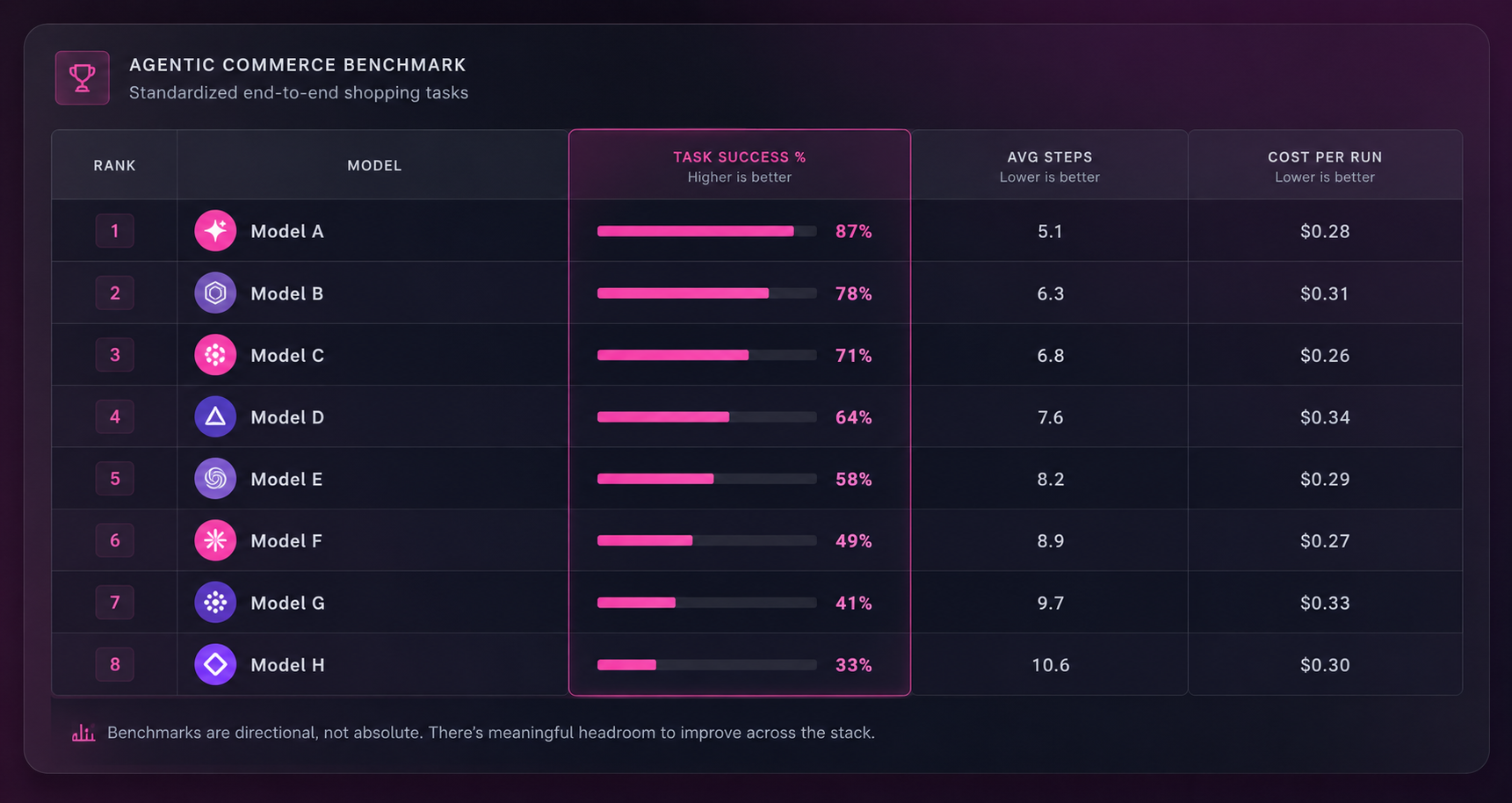
In one of our internal evaluation passes, we used a curated set of hundreds of tasks and a standardized ReAct-style architecture (the "Lazer Loop") to compare current models. The headline result was that even the strongest models completed a meaningful fraction of tasks successfully, yet still had plenty of headroom on the most complex flows like multi-step checkout.
The way we interpret this is optimistic. Agents are already good enough to be useful in production when you design systems with them in mind. At the same time, there is clear room for improvement that can be driven by better environments, better rails, and better task design.
Agentic commerce as a systems problem
One of the biggest lessons from our work so far is that agentic commerce will be won by teams that care about systems design, not just interface novelty.
The hard parts sit underneath the chat window:
- Structured catalog data that models the products the way both humans and agents need to see them.
- Pricing and inventory integrity so that what the assistant promises is what the systems can fulfill.
- Checkout flows that are interoperable with protocols like UCP and ACP instead of being tightly bound to one front end.
- Payment orchestration that anticipates agent-led purchase patterns across cards, wallets, and subscriptions.
- Observability so that engineering, product, and growth teams can see what is happening inside these channels and respond quickly.
The opportunity is also broader than just enabling purchases inside AI assistants. It includes:
- Discoverability across LLM-driven surfaces, where structured catalog and content quality directly affect whether you are recommended.
- Agent-compatible storefronts that are easier for assistants to interpret and act on.
- AI-attributed revenue measurement that connects assistant behavior to financial outcomes.
- Internal AI workflows for commerce and engineering teams that shorten the loop from idea to shipped change, including agents for support triage, merchandising ops, and development itself.
In other words, agentic commerce is not one feature. It is a new operating layer for commerce.
How technical leaders can prepare
This category is early, but it is moving quickly. Brands do not need to rewrite their entire stack this quarter. They do need to start preparing in concrete ways.
For most technical and product leaders, that looks like:
Instrument reality
Get a clear view of current agent-driven traffic and behavior across Shopify and AI surfaces, even if volumes are small.
Clean up catalog and policy semantics
Invest in structured product data, clear pricing and promo rules, and explicit policies that protocols like UCP and ACP can read.
Make checkout and payments legible
Ensure that discounting, loyalty, subscriptions, and region-specific rules have an API representation, not just view logic.
Plan a sidecar or pilot
If a full replatform is not feasible, consider a narrow agentic pilot on a subset of catalog or a parallel Shopify stack that is built from the start to be agent-friendly.
Engage with evaluation, not anecdotes
Use tools like CommerceBench or similar internal harnesses to see how agents behave in your actual environments, then simplify or redesign flows that consistently cause issues.
The window where "wait and see" is a safe strategy is getting smaller. The teams that start structuring for agent-readiness now will be in a better position when AI-assisted shopping becomes a default behavior rather than a novelty channel.
Move your agentic commerce from demo to distribution.
Much of our work at Lazer is now focused on helping companies bridge that gap between experimentation and production. The goal is simple. Make their systems discoverable, transactable, and measurable across the emerging agentic web, in a way that respects the complexity of real commerce and gives them control over how value flows through these new rails.

